Events

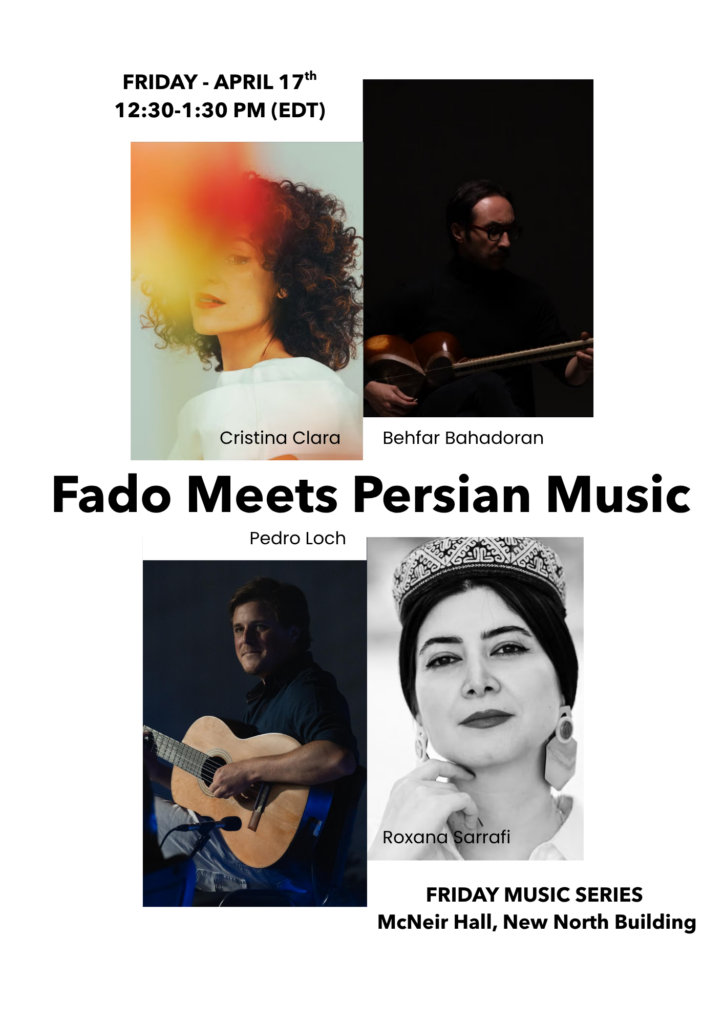
Fado Meets Persian Music

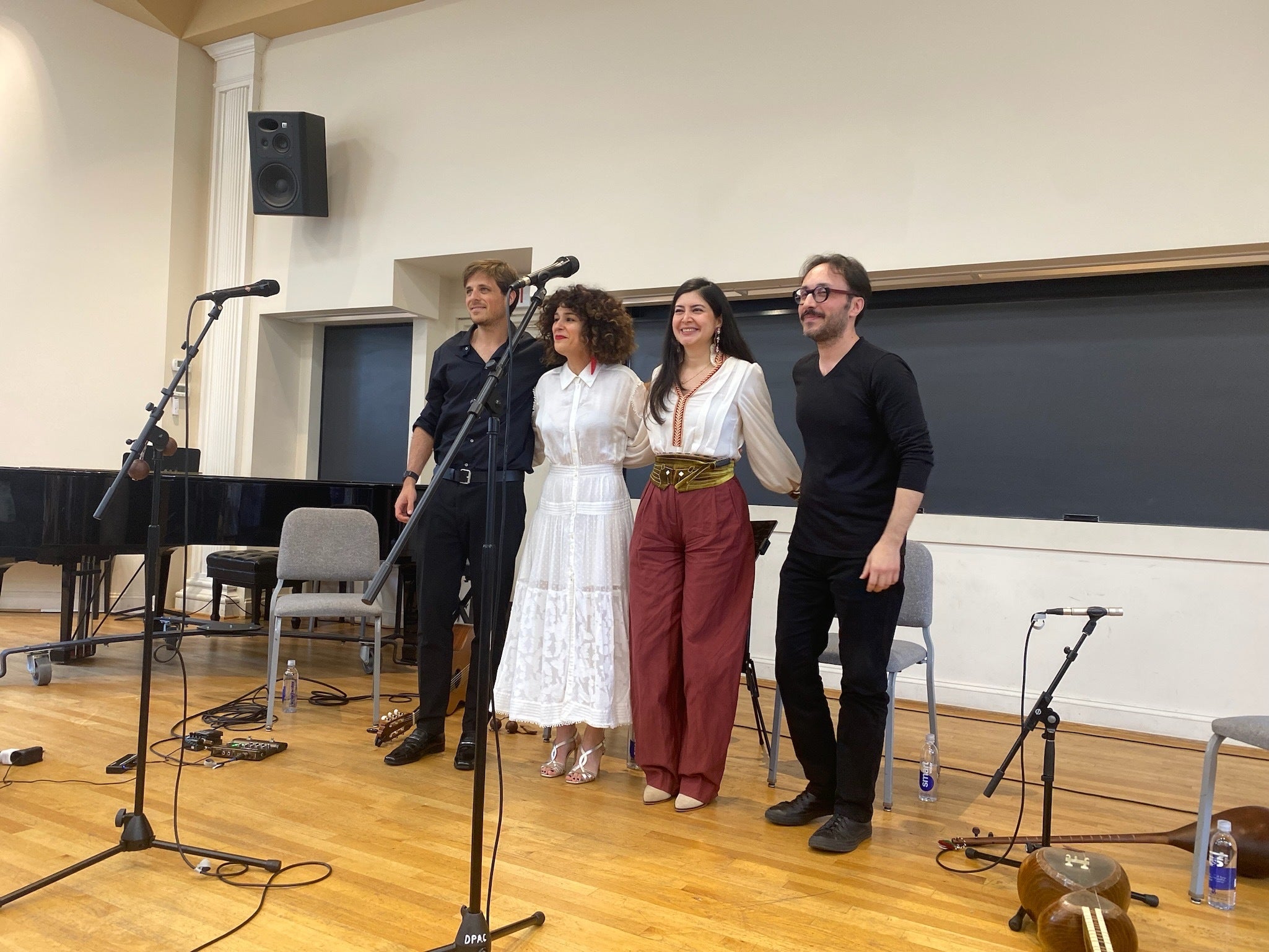
Portuguese singer Cristina Clara and Iranian composer Behfar Bahadoran, joined by Iranian singer Roxana Sarrafi and guitarist Pedro Loch, explore the deep-rooted connections between Portuguese and Persian musical languages through a repertoire of oral and classical tradition and poetic subtlety.  A dialogue between four musicians whose work is anchored in tradition although open to contemporary sonorities.  

Cristina Clara is a Portuguese singer whose work draws inspiration from traditional Portuguese songs, including fado, and from the musical traditions of other Portuguese-speaking countries such as Cape Verde and Brazil. Joined by guitarist Pedro Loch, she brings a repertoire shaped by oral tradition, poetic nuance, and a contemporary sensibility. In partnership with Persian classical and traditional vocalist Roxana Sarrafi and Iranian composer and multi-instrumentalist Behfar Bahadoran, this concert creates a dialogue between Portuguese and Persian-rooted musical languages, tracing shared emotional depth, subtlety, and openness to reinvention.

This event is part of a collaborative project organized by the Director of the Persian Studies Program, Farima S. Mostowfi, and the Camões Portuguese Lecturer, Glória Alhinho, at Georgetown University. 

Persian classic Music and Fado have many affinities: embody intense passion and dramatic contrasts. They carry the translation of individual and collective experiences simultaneously, and ​​the mediation of a moment and the transcendent encounter between the singer and the poet. They are journeys through our inner lives, our intimacy and subsequent expression of feelings and emotions. For that reason, they embody intense passion and dramatic contrasts. They carry the translation of individual and collective experiences simultaneously, and the mediation of a moment and the transcendent encounter between the singer and the poet. Both musical worlds create an intimate ambiance between musicians and the audience. They have improvisation at its core, and the voice as an instrument and the instrument as a distinctive voice. Style is therefore a central element, as it depends on the atmosphere, and state of mind.
Design, conceptualization, development and presentation: Glória Alhinho

Cristina Clara transforms the stage into a space of closeness, freedom, and beauty. With a versatile voice and a strong presence, she moves naturally between intimacy and expansiveness. Each concert is a shared experience with the audience, where tradition and contemporaneity engage in open dialogue.

Originally from Minho – in the North of Portugal – and based in Lisbon since 2005, she is a singer and songwriter whose journey is rooted in the oral music tradition, which she embraces as a living form of connection between cultures, territories, and people. A registered nurse by training, she studied singing and theatre, but it was an invitation from renowned fado singer Marco Rodrigues to perform at the historic Café Luso that marked the true beginning of her musical career.

Her debut album – Lua Adversa -, released in 2021, was featured as Disco Antena 1, supported by the Fado Museum and distributed by Sony Music. Co-produced by Cristina Clara, Pedro Loch, and Edu Miranda, it blends original and traditional repertoire and features renowned musicians with backgrounds in jazz and folk traditions.

Her close connection to Cape Verdean and Brazilian cultures has been central to shaping her artistic voice, inspiring her to explore poetic and harmonic affinities between genres such as Fado, Morna, and Samba-canção.

Deeply passionate about traditional practices and aware of the vital role of women in their transmission, she incorporates hand percussion instruments like the adufe and tracanholas into her performances—elements linked to the ancestral feminine universe. In this context, her live collaborations with Cape Verdean batukaderas groups such as Freirianas and Delta Ramantxadas on the island of Santiago began in 2018.

Cristina Clara is a Portuguese singer and songwriter who delves into the traditions of Portuguese-speaking communities to create a repertoire rich in diversity and emotion. Her concerts blend traditional themes with original songs born from cultural encounters — freely exploring tunings, rhythms, and languages with artistic liberty and poetic sensitivity. 

On stage, the artist presents the sound of her lived experience in Portugal and across the countries she has visited throughout her journey. An eclectic sound shaped by instruments like the adufe, tracanholas, and kass kass — ancestral percussions tied to the feminine universe and the heartbeat of the earth. 

Accompanied by musicians rooted both in jazz and in orally transmitted folk traditions, Cristina Clara shapes a contemporary, organic, and surprising sound. With roots in Lisbon fado and an eye toward the diverse soul of Portuguese identity, Cristina Clara sings today’s stories with emotion and elegance.

Born in Tehran/Iran in 1987, Behfar is a multi-instrumentalist. Behfar started his formal training in Persian Classical music with Homayoun Khorram studying the Iranian style of violin at the age 6. As he was more exposed to the mystical world of Persian classical and folklore music, he started playing Daf with Arsalan Sadigh and Ramin Rahimi mastering the instrument in a very short time.  

He took classes with great Iranian classical and folklore music masters including, Darioush Talaei, Ali-Akbar Moradi and Hamid Motebassem. Behfar established Pejvâk Ensemble in 2006 with which performed many concerts in the United States. He cofounded the Sorvâd ensemble in 2020 and went on the North American tour in 2022 with Iranian master percussionist Pejman Hadadi and Mojgan Shajarian. Behfar performed alongside many well known musicians including, Majid Derakhshani, Alireza Shahmohammadi, Pejman Hadadi, Pezhham Akhavass, John Wubbenhorst, Larry Mitchell, Dawn Avery, Kazem Davoudian, Susan Deyhim, Mojgan Shajarian and Mahboubeh Golzari.

Behfar performed in some of the most prestigious venues in the United States including the Palace of Fine Arts in San Francisco; Lincoln Center and Metropolitan Museum of Art in New York; Kennedy Center and Freer Sackler Gallery in Washington D.C. 

Roxana Sarrafi is a Persian classical and traditional vocalist, born in Iran, whose passion for music began at an early age. She started singing and playing the setar and tar at the age of 11, developing a deep connection to Persian musical traditions. Although she earned a master’s degree in law, her devotion to music led her to pursue singing as a professional career.

Since 2000, Roxana has studied Persian classical vocal music with renowned masters including Gh. Rezai, H. Nourbakhsh, and Parisa. She also trained in music theory and solfège with Siavash Roshan, gaining a strong technical foundation and a profound understanding of Persian Radif. 

Roxana has performed extensively in Iran, collaborating with distinguished artists such as Alireza Ghorbani, Ali Ghamsari, and Ramin Behna. After relocating to the United States, she has continued sharing Persian classical music with diverse audiences through concerts and tours across Washington, D.C., Virginia, Texas, California, and other major cities. In 2023 and 2025, she participated in the Silk Road Workshop in Boston, learning and performing with internationally acclaimed artists including Abeer Nehme, Mike Block, Kala Ramnath, and Veronica Robles.

Through her performances, collaborations, and teaching, Roxana Sarrafi is dedicated to preserving and sharing the rich heritage of Persian classical music while building meaningful cultural connections with audiences worldwide.

Loch is a guitarist and composer born in Florianópolis (Brazil) but currently based in Lisbon. He stands out for his remarkable rhythmic style and a deeply distinctive sound. With compositions that blend the languages of popular and classical music, he has already built a diverse body of work within the genres of Brazilian music and jazz, while frequently venturing into other realms such as traditional Argentine, Portuguese, and Cape Verdean music. He earned a degree in Music from the University of the State of Santa Catarina in 2012, studied Jazz at Morehead State University (USA), and completed a Master’s degree in Jazz Performance at the ESML in Lisbon.

Tagged
event
fado
music
persian